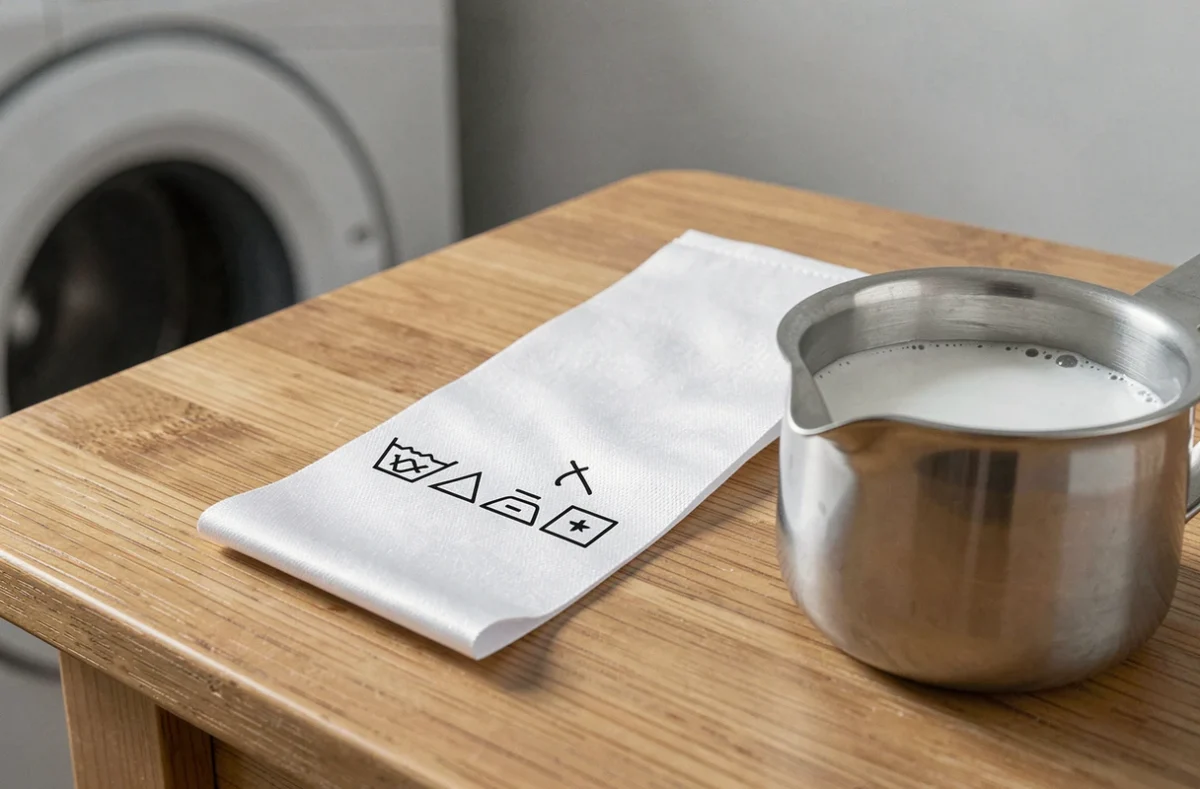
Textile labels and washing machine control panels use a standardized pictogram system governed by the NF EN ISO 3758 standard. This system is based on five families of symbols (washing, bleaching, drying, ironing, professional cleaning) whose interpretation affects the lifespan of clothing and household linen. Confusion between these pictograms remains one of the main causes of premature textile deterioration.
Maximum temperature and mechanical action: what the tub really indicates
The pictogram in the shape of a tub, present on every textile label, is the most consulted. The number inside (30, 40, 60, or 90) indicates the maximum temperature not to be exceeded, not the recommended temperature. Washing at a lower temperature is still possible and helps preserve the fibers.
A detail often overlooked concerns the horizontal lines under the tub. They do not change the temperature: they indicate a reduced level of mechanical action. One line under the tub corresponds to a moderate treatment (synthetic or delicate program). Two lines impose a very moderate treatment, typically the wool or silk program.
Two garments displaying the same maximum temperature may therefore require different programs. A pair of jeans at 40 °C without a line and a blouse at 40 °C with two lines should not be washed together in the same cycle. To understand the laundry symbols on a washing machine, it is essential to systematically associate the temperature with the number of lines.
The tub crossed with a cross means that machine washing is prohibited. The tub with a hand indicates hand washing only, generally at a temperature not exceeding 40 °C.
Washing machine detergent compartments: what do the symbols I, II, and the clover mean
The washing machine drawer generally has three compartments. Their markings vary by manufacturer, but the most common convention uses Roman numerals and a floral pictogram.
- The compartment marked I receives detergent for pre-wash, used only for very dirty laundry. Most common cycles do not go through this compartment.
- The compartment marked II receives detergent for the main cycle. This is the one to fill systematically, regardless of the program chosen.
- The compartment marked with a clover pictogram (or flower) is reserved for fabric softener. Pouring detergent into this compartment compromises rinsing, as the product is released at the end of the cycle.
Confusing compartments I and II does not cause an immediate disaster, but the laundry comes out poorly washed: the detergent from compartment I is drained before the main cycle if no pre-wash is selected. Checking the drawer markings when installing a new machine prevents this recurring problem.
Care symbols beyond washing: drying, ironing, and bleaching
The square represents drying instructions. A circle inside a square indicates tumble drying (dryer). The dots inside the circle specify the allowed heat intensity: one dot for low heat, two dots for normal heat. A crossed square prohibits any tumble drying.
The iron works on the same principle of dots. One dot allows ironing at low temperature (suitable for synthetics), two dots for medium temperature (wool, silk), three dots for high temperature (cotton, linen). A crossed iron prohibits ironing.
The bleaching triangle
The empty triangle allows any type of bleaching. A triangle containing two diagonal lines restricts bleaching to oxygen (no chlorine). A crossed triangle prohibits any bleaching agent, including detergents containing sodium percarbonate.
The lone circle concerns professional cleaning (dry cleaning). The letters inside (P, F, W) indicate the type of solvent allowed. These indications are aimed at laundry professionals and have no direct utility for domestic washing.

Manufacturer pictograms on the control panel: a non-standardized logic
The symbols engraved on the program selector of the machine do not fall under the ISO 3758 standard. Each manufacturer (Bosch, Siemens, Whirlpool, Bellavita) uses its own pictograms to designate cycles. A snowflake may mean cold wash at one manufacturer and wool program at another.
The manufacturer’s manual remains the only reliable reference for associating a machine pictogram with a specific program. The symbols on the textile label indicate the limits of the garment, while those on the machine designate a cycle. The user’s task is to match the two.
Some visual cues frequently recur: the drawing of a t-shirt indicates a cotton program, a spool of thread suggests synthetics, a ball of wool indicates the wool cycle, and a hand in a tub signifies hand washing. These conventions remain indicative and vary from model to model.
The care label is designed to prevent irreversible damage to the garment. It indicates the most severe treatment tolerated by the textile, without guaranteeing a suitable result if the machine program is not appropriate. Respecting the temperature is not enough: the type of cycle (spinning, duration, mechanical action) matters as much as the displayed degrees.